
What your TCR sequencing data reveals about vaccine response and infectious disease
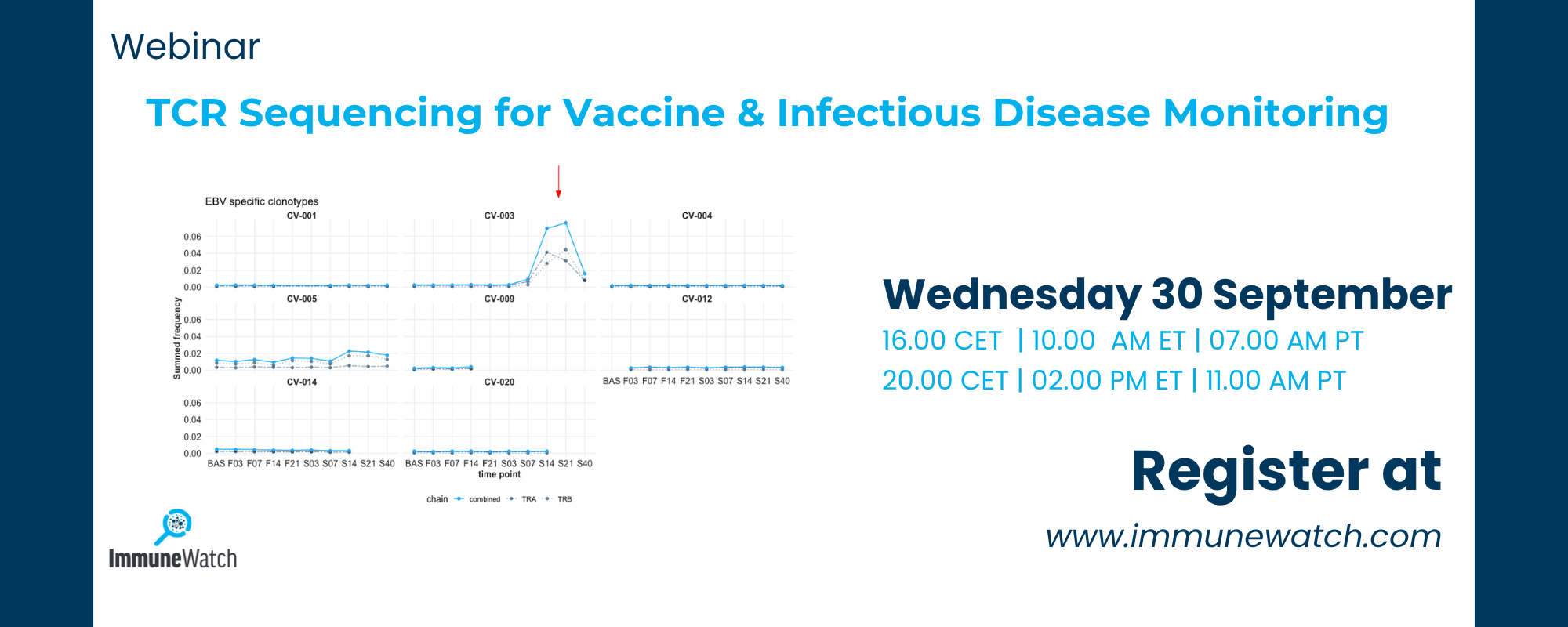
Most immune monitoring still stops at the antibody titer. But TCR sequencing can show you something more specific: which antigen-specific T-cell clones expanded, when, and how strongly, whether that antigen came from a vaccine or a pathogen.
In this webinar, we'll walk through how epitope-specific T-cell annotation applies to vaccine-response monitoring and pathogen-specific immune tracking, using real examples: tracking SARS-CoV-2-specific TCR clonotypes to see vaccination response as a clear signal in the data, and surfacing pathogen exposure that wasn't even the original target of the analysis.
This signal isn't confined to infectious disease either. Some of the same virus-specific markers, CMV and EBV among them, turn out to matter in cancer and transplant research too, a sign of how broadly this kind of pathogen-specific T-cell tracking applies.
What you'll take away:
- What a genuine vaccine-induced T-cell response looks like in TCR repertoire data
- How to separate antigen-specific signal from background noise
- Several real-world examples of vaccine and infectious disease monitoring using TCR sequencing and epitope annotation
This session is for anyone working on vaccine development, immunomonitoring, or infectious disease research who generates, or is considering generating, TCR-sequencing data. We'll close with time for questions.
Stay up to date
Subscribe to our newsletter to receive useful tips and information.

.gif)


