From Adaptive to Harell: Harlan Robins on TCR sequencing and the data bio-AI still needs
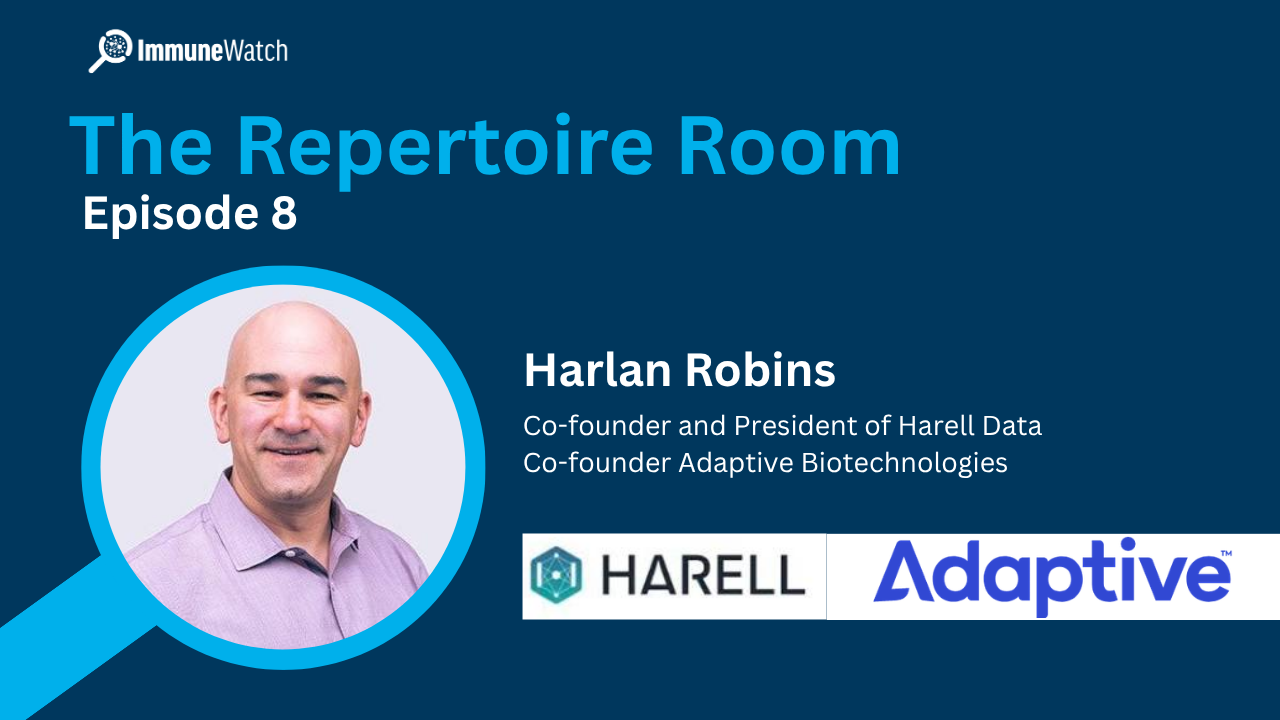
Before high-throughput sequencing, T cell receptors were run out on a gel. That showed how many receptors had a given length, but not a single sequence. Harlan Robins, co-founder of Adaptive Biotechnologies and Harell Data Corp, joins Sander Wuyts in episode 8 of the Repertoire Room to talk about what changed when his team started sequencing across the receptors, and why he now thinks the next bottleneck is training data.
From a gel to six million T cell receptors
At Fred Hutchinson Cancer Center, Harlan was analysing T cell receptor data that had been run out on a gel, which is not a great way to estimate repertoire diversity. With the institute's new Solexa sequencers just installed, the obvious question was: why not sequence across the receptors directly? The first run failed because the primers pointed the wrong way. The second returned six million T cell receptors from a single human sample, orders of magnitude more than existed in the literature at the time.
After a talk at a solid organ transplant conference, around ten clinicians asked to use the technology. Harlan was already using 95% of the institute's sequencing capacity, so in 2009 he and his brother started Adaptive Biotechnologies.
Blood cancer monitoring and the repertoire as a ledger
Blood cancer monitoring was the most direct first application. A B or T cell cancer is clonal, so its receptor sequence acts as a barcode that TCR and BCR sequencing is built to read. Adaptive now monitors blood cancers in hundreds of thousands of patients.
Harlan sees much more in the repertoire: "Your immune repertoire should be a ledger of every disease you've ever had and all the diseases you have right now." Reading it has been harder than expected, but machine learning and large disease-specific datasets are starting to change that.
Harell: training on data that cannot be downloaded
Harell Data Corp started with a practical problem. After a Genentech partnership changed direction, Adaptive held a large TCR-antigen binding dataset designed to train binding models, but only a small ML team to use it. Harell hosts proprietary datasets on a protected cloud platform. ML teams can train on the data and keep their models, the data cannot be downloaded, and the data owner receives a share of the revenue.
Datasets from Adaptive (TCR-antigen binding) and A-Alpha Bio (antibody binding) are already available, with small molecule and enzyme binding datasets in discussion. Each dataset has a blind test set and leaderboard, and a model marketplace is planned.
About the guest
Harlan Robins completed a PhD in string theory and a postdoc at the Institute for Advanced Study in Princeton before moving into computational biology at Fred Hutchinson Cancer Center. He co-founded Adaptive Biotechnologies in 2009 and is co-founder of Harell Data Corp.
Stay up to date
Subscribe to our newsletter to receive useful tips and information.